Your Ultimate Guide to Choosing the Best SEO Agency in Gurgaon for Schools and Colleges
The digital landscape has transformed how students and parents discover educational institutions. A stunning campus and excellent faculty mean nothing if prospective students can't find you online. SEO (Search engine optimization) has become as critical to enrollment success as academic reputation and campus facilities. This guide reveals how educational institutions can dominate search results and attract the right students.
Many educational institutions partner with a professional SEO agency in Gurgaon to strengthen their digital presence. Expert SEO services in Gurgaon help schools, colleges, and universities reach prospective students through targeted search visibility.
Why SEO Matters for Educational Institutions?
SEO for educational institutions isn't a luxury—it's survival in an increasingly competitive market. Every year, millions of students begin their education search with a Google query, not a campus visit. Traditional marketing channels like brochures and college fairs now play supporting roles to digital discovery. If your institution doesn't appear on the first page of search results, you've essentially disappeared from consideration.
The enrollment funnel now starts with search visibility, not campus tours. Prospective students research programs, compare institutions, and eliminate options entirely online before ever contacting admissions. Your competitors understand this shift and are investing heavily in digital presence. Schools that ignore search optimization are losing qualified applicants to institutions with inferior programs but superior online visibility.
SEO for schools directly impacts enrollment numbers and institutional sustainability. Higher search rankings translate to more website visitors, more application inquiries, and ultimately more enrolled students. The cost per acquisition through organic search is dramatically lower than paid advertising or traditional recruitment methods. Every dollar invested in sustainable SEO delivers compounding returns year after year.
Institutions looking to compete online often rely on an experienced SEO company in Gurgaon that understands education marketing and student search behavior.
Read Also : How to choose Ecommerce website development agency and SEO service provider ?
Understanding the Educational Search Landscape
SEO for colleges operates in a unique ecosystem with distinct search patterns and user behaviors. Prospective undergraduate students search differently than graduate program seekers or continuing education learners. Parents researching K-12 options use entirely different keywords than high school seniors exploring universities. Understanding these nuanced search behaviors is fundamental to effective optimization.
Search intent varies dramatically across the enrollment journey. Early-stage researchers use broad queries like "best engineering colleges" or "private schools near me." Mid-funnel prospects search for specific information: program requirements, campus facilities, student life details. Late-stage applicants look for application deadlines, financial aid information, and enrollment procedures. Your content strategy must address every stage of this journey.
SEO for universities must account for multiple audiences beyond just prospective students. Alumni search for networking opportunities and giving portals. Researchers look for faculty expertise and published papers. Community members seek continuing education programs and public events. A comprehensive SEO strategy serves all these constituencies while prioritizing enrollment-focused content.
Foundation: Technical Excellence for Education Websites
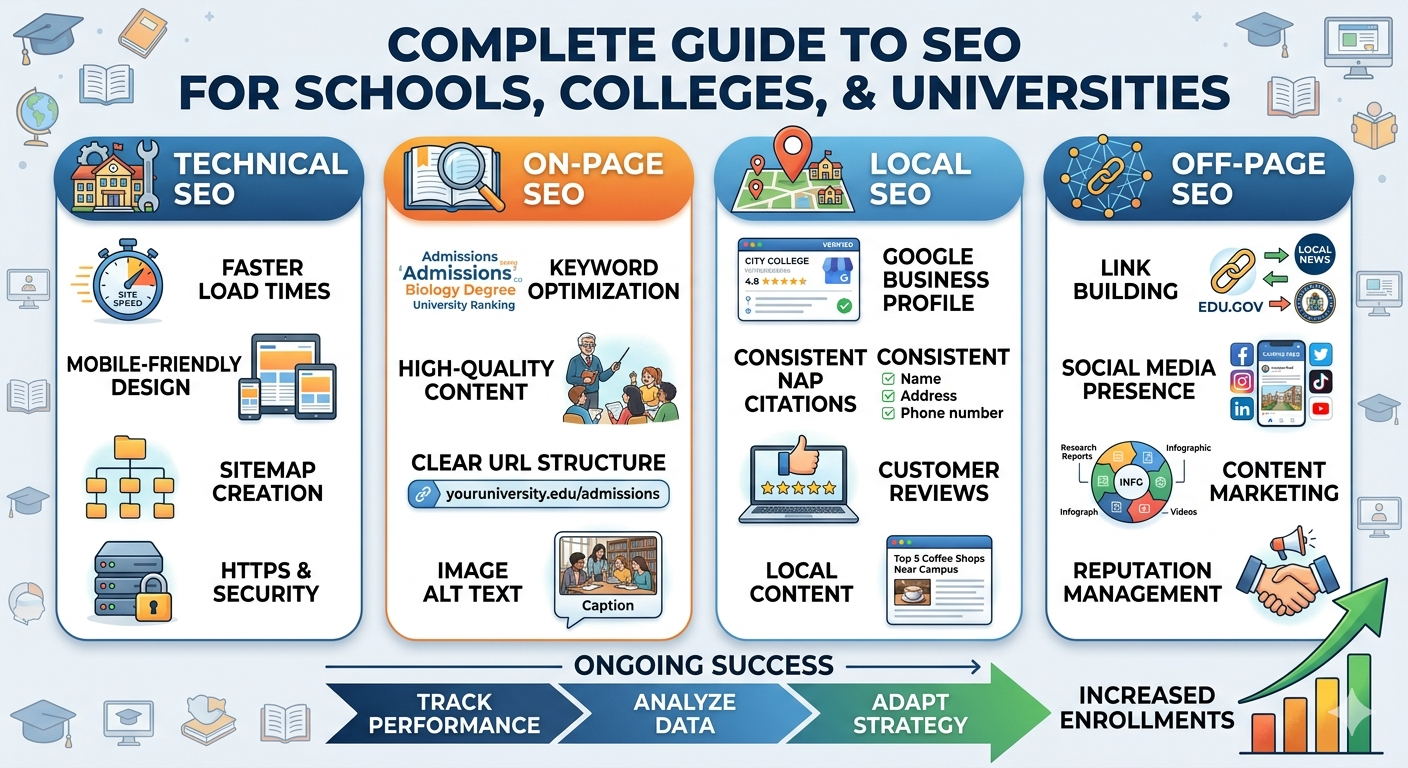
Technical SEO for education websites creates the infrastructure that allows all other optimization efforts to succeed. Search engines can't rank content they can't properly access, crawl, and understand. Your website's technical foundation determines whether Google can effectively index your hundreds or thousands of pages. Neglecting technical optimization is like building a beautiful building on a cracked foundation.
Site speed dramatically affects both search rankings and user experience. Students expect instant page loads on mobile devices, not frustrating delays. Google's Core Web Vitals now directly influence rankings, measuring loading performance, interactivity, and visual stability. Educational websites, often bloated with legacy code and oversized images, frequently fail these critical benchmarks.
Mobile responsiveness isn't optional—it's fundamental to modern SEO for education websites. Over 60% of education-related searches now happen on smartphones and tablets. Google's mobile-first indexing means your mobile site version determines your search rankings. Sites that deliver poor mobile experiences don't just frustrate users; they disappear from mobile search results entirely.
Security through HTTPS encryption is now a ranking factor and a trust signal. Educational institutions handle sensitive student data, making security paramount. An SEO friendly school website must load securely, function flawlessly across devices, and provide instant access to information. These technical fundamentals enable everything else in your SEO strategy.
Read Also : Embracing Organic SEO With the Best Digital Marketing Agency
Content Strategy: The Heart of Education SEO
Content quality separates institutions that rank from those that don't. Generic program descriptions copied from accreditation documents don't engage readers or satisfy search intent. Education SEO services that deliver results build comprehensive content addressing every question prospective students ask. Your content should demonstrate subject matter expertise, build trust, and provide genuine value beyond promotional messaging.
A trusted SEO agency in Gurgaon can help educational institutions build content strategies that attract students searching for courses, career paths, and admission opportunities online.
Program pages must go far beyond basic degree requirements and course listings. Students want to know career outcomes, faculty credentials, research opportunities, internship partnerships, and student success stories. Each program page should target specific search queries that prospects actually use. Shallow, templated content loses to rich, detailed pages that thoroughly answer searcher questions.
Blog content establishes topical authority and captures informational search traffic. Articles addressing "how to choose a college major" or "engineering career paths" attract early-stage prospects. Digital marketing for educational institutions leverages content to build relationships long before application season. Educational, non-promotional content builds trust and positions your institution as a helpful authority.
Video content increasingly dominates search results and engagement metrics. Campus tours, student testimonials, faculty interviews, and day-in-the-life content provide authentic glimpses into institutional culture. Google now prominently displays video results for many educational queries. Institutions that ignore video content surrender valuable search real estate to competitors.
Keyword Research for Educational Institutions
How to do SEO for schools begins with understanding exactly what prospective students are searching for. Generic assumptions about search behavior lead to wasted effort and missed opportunities. Comprehensive keyword research reveals the actual phrases, questions, and terms your target audience uses. Data, not guesswork, should drive your entire content and optimization strategy.
Different educational levels require different keyword strategies. K-12 institutions should target location-based searches like "private elementary schools in [city]" or "best high schools near me." Higher education SEO focuses on program-specific terms, degree types, and academic specializations. Graduate programs compete for highly specific long-tail keywords with clear intent.
Search volume matters less than search intent and conversion potential. A keyword with 100 highly-qualified monthly searches outperforms a vanity term with 10,000 irrelevant searches. SEO strategies for colleges and universities prioritize keywords that indicate enrollment intent over general curiosity. Target phrases like "MBA program requirements" rather than just "MBA."
Competitor analysis reveals keyword opportunities and content gaps. Identify what search terms competitor institutions rank for that you don't. Discover which content types dominate search results for your target keywords. Best SEO practices for educational institutions include continuous monitoring of the competitive search landscape and adapting strategy accordingly.
Professional SEO services in Gurgaon use advanced keyword research tools to identify high-intent search queries that prospective students and parents frequently use.
Local SEO: Dominating Geographic Search
Local SEO for schools and coaching institutes determines visibility for the most valuable searches: those with location intent. When parents search "best schools near me" or students look for "colleges in [state]," appearing in local results directly impacts applications. Local search optimization is particularly critical for institutions that primarily serve regional populations.
Google Business Profile optimization is foundational to local visibility. Claim and fully complete your profile with accurate information, compelling descriptions, and high-quality photos. Regular updates, posts, and engagement signal active management to Google. How schools can rank on Google locally starts with mastering this free but powerful tool.
Location pages for multi-campus institutions require careful optimization. Each campus location needs a dedicated page with unique content, local information, and embedded maps. Duplicate content across location pages damages rankings rather than helping. Every campus page should emphasize local partnerships, community involvement, and region-specific programs.
Local citations—mentions of your institution's name, address, and phone number across the web—build local authority. Consistent NAP (Name, Address, Phone) information across directories, review sites, and local resources strengthens local rankings. Directory listings, chamber of commerce memberships, and local news mentions all contribute to local search performance.
Local optimization strategies implemented by an experienced SEO agency in Gurgaon help educational institutions rank higher in regional searches, attracting students from nearby cities and improving admission inquiries.
On-Page Optimization Essentials
Title tags and meta descriptions are your advertisement in search results. These elements don't just affect rankings; they determine click-through rates from search results pages. Every program page, blog post, and landing page needs unique, compelling titles that incorporate target keywords naturally. Generic or duplicate titles waste precious ranking opportunities.
Header hierarchy (H1, H2, H3 tags) structures content for both users and search engines. Your H1 should clearly state the page's primary topic and include your main keyword. Subheadings should break content into scannable sections while incorporating related keywords. SEO tips for education websites emphasize clear information architecture that serves both readers and algorithms.
Internal linking connects related content and distributes page authority throughout your site. Link from program pages to relevant faculty profiles, research centers, and career outcome statistics. Blog posts should link to relevant program pages and resources. Digital marketing strategies for colleges require strategic internal linking that guides users through the enrollment journey.
Image optimization improves page speed and provides additional ranking opportunities. Descriptive file names, alt text, and compressed file sizes all matter. Every campus photo, infographic, and diagram should include keyword-relevant alt text that describes the image. Visual content should enhance rather than hinder page performance.
Read Also : On-Page SEO: What it is and 12 Effective Techniques to Optimize Your Site
Link Building for Academic Authority
Backlinks from reputable websites signal authority and trustworthiness to search engines. Quality matters infinitely more than quantity in link building. A single link from a .edu domain or respected industry publication outweighs hundreds of low-quality directory links. Education website SEO audit processes always include comprehensive backlink profile analysis.
Natural link acquisition happens when you create genuinely valuable content. Original research, comprehensive guides, and unique data attract organic links from journalists, bloggers, and other institutions. Press releases about achievements, innovations, or community initiatives generate media coverage and backlinks. Your institution's newsworthy activities are link-building opportunities.
Strategic partnerships and community involvement create link opportunities. Local business sponsorships, chamber of commerce memberships, and community event participation often result in website links. Academic partnerships, research collaborations, and conference participation generate high-authority .edu backlinks. Community engagement simultaneously serves institutional mission and SEO objectives.
Faculty expertise attracts links when properly promoted. Professors who contribute expert quotes to journalists, publish research, or speak at conferences generate backlinks to institutional pages. Creating faculty profile pages optimized for their areas of expertise makes them more discoverable to media and researchers. Your academic talent is an underutilized link-building asset.
Measuring Success: Analytics and Continuous Improvement
Analytics implementation establishes baseline metrics and clear success indicators. Organic traffic, keyword rankings, and conversion rates provide quantifiable performance measures. Set specific, measurable goals: increase organic applications by 20%, rank in the top 3 for 15 priority keywords, or reduce cost per enrollment by 30%. Vague objectives produce vague results.
Google Analytics reveals how search traffic behaves once it reaches your website. Track which pages attract traffic, where users engage deeply, and where they abandon the site. Enrollment inquiry form submissions, application starts, and campus visit registrations are conversion goals worth tracking. Understanding user behavior patterns informs optimization priorities.
Google Search Console provides direct insight into search performance. See which queries trigger your site in results, your average rankings, and click-through rates. Identify pages with high impressions but low clicks—these need better titles and descriptions. Discover technical issues, mobile usability problems, and indexing errors that damage performance.
Regular competitive analysis keeps your strategy ahead of rivals. Monitor competitor keyword rankings, content strategies, and backlink acquisition. Education website design SEO isn't a one-time project but an ongoing competitive process. Markets shift, algorithms evolve, and new competitors emerge—continuous adaptation is essential.
Partnering with a results-driven SEO company in Gurgaon ensures institutions continuously track rankings, improve organic traffic, and generate qualified student leads.
Common SEO Mistakes Educational Institutions Make
Duplicate content across program variants damages rankings rather than helping. Many institutions create separate pages for "Bachelor of Science in Biology" and "BS Biology" with identical content. Search engines struggle to determine which page to rank, often ranking neither effectively. Consolidate similar content or create meaningfully different pages with unique value propositions.
Neglecting user experience in favor of keyword optimization backfires. Keyword-stuffed content that reads unnaturally frustrates users and triggers algorithm penalties. Website optimization for colleges prioritizes user needs first, incorporating keywords naturally within genuinely helpful content. Search engines increasingly reward user satisfaction signals like time on page and low bounce rates.
Ignoring accessibility excludes users and harms SEO performance. Screen reader compatibility, keyboard navigation, and proper semantic HTML all affect both accessibility and search rankings. Educational institutions, of all organizations, should lead in digital accessibility. Accessible websites rank better and serve all prospective students effectively.
Impatience derails otherwise solid SEO strategies. Sustainable rankings require months of consistent effort, not days or weeks. Institutions that abandon optimization after a month of minimal results never achieve the compounding benefits of long-term strategy. SEO is a marathon requiring sustained commitment, not a quick fix.
Advanced Strategies: Schema Markup and Rich Results
Schema markup helps search engines understand institutional information with precision. Educational organization schema identifies your institution type, programs, campuses, and accreditation. Course schema can trigger rich results showing program details directly in search results. Comprehensive structured data implementation provides competitive advantages in search visibility.
Event schema for campus tours, open houses, and information sessions can display event details directly in search results. FAQ schema allows frequently asked questions to appear as expandable rich results. Review schema aggregates ratings and testimonials into star ratings visible in search results. These enhanced listings increase click-through rates significantly.
Local business schema reinforces geographic relevance for local searches. Mark up campus locations, contact information, and service areas. The more context you provide search engines, the better they can match your institution to relevant queries. SEO for academic institutions requires technical sophistication beyond basic optimization.
Video schema ensures your video content appears in video search results and rich snippets. Mark up campus tours, testimonials, and informational videos with appropriate structured data. Search engines can display video thumbnails, duration, and upload dates directly in results. Proper video optimization captures attention in crowded search results pages.
The Enrollment Journey: Aligning SEO with Student Decision-Making
Understanding the prospective student journey is fundamental to effective SEO strategy. Awareness-stage students need educational content, not sales pitches. Consideration-stage prospects want detailed program information and comparison tools. Decision-stage applicants require clear application instructions and deadline information. Your content must serve every stage appropriately.
Top-of-funnel content attracts early researchers through informational queries. Blog posts, guides, and educational resources answer questions without pushing enrollment. Middle-of-funnel content helps prospects evaluate your institution against alternatives. Detailed program pages, outcome statistics, and campus resources facilitate comparison. Bottom-of-funnel content removes application barriers and answers final questions.
Conversion optimization extends beyond keyword rankings to user experience. Clear calls-to-action, simplified application processes, and mobile-friendly forms convert traffic into applicants. High rankings mean nothing if your website fails to convert visitors. Technical performance, persuasive content, and friction-free processes work together to drive enrollment.
Frequently Asked Questions
Q1: How long does it take to see SEO results for an educational institution?
Most educational institutions begin seeing initial improvements in 3-4 months, with significant results appearing after 6-9 months of consistent optimization. Rankings for competitive keywords like "best MBA programs" may take 12-18 months to achieve top positions. Quick wins often come from optimizing existing high-performing pages and targeting long-tail keywords with lower competition. SEO compounds over time, so institutions that maintain consistent efforts for 2-3 years typically dominate their search landscape completely.
Q2: Should we hire an in-house SEO specialist or outsource to an agency?
In-house specialists excel when you have ongoing content needs, multiple campuses, and complex technical requirements that demand daily attention and institutional knowledge. Agencies bring diverse expertise, proven strategies across multiple institutions, and specialized skills in areas like link building and technical audits. Mid-sized institutions often benefit from a hybrid approach: an in-house coordinator managing day-to-day tasks with agency support for strategy and specialized execution. Smaller schools with limited budgets typically achieve better ROI through agency partnerships rather than hiring full-time staff.
Q3: What's the biggest SEO mistake educational institutions make that costs them enrollments?
The most damaging mistake is treating every program page identically with templated, thin content that fails to differentiate offerings or address student concerns. Pages that simply list course codes and credit requirements without explaining career outcomes, faculty expertise, or unique program advantages rarely rank or convert. Institutions lose thousands of potential applicants annually by creating dozens of nearly-identical pages that confuse search engines and bore prospective students. Investing in rich, unique content for your top 10-15 priority programs delivers far better results than maintaining 100 shallow pages.
Q4: How can smaller institutions compete against well-established universities in search rankings?
Smaller institutions win by dominating hyper-specific niches rather than competing for broad terms like "best universities." Target long-tail keywords combining location, program specifics, and student characteristics: "accelerated nursing program for working professionals in Dallas" instead of just "nursing programs." Build genuine local authority through community partnerships, local media coverage, and alumni success stories. Create exceptionally detailed content around specialized programs where you genuinely excel, becoming the definitive resource that naturally attracts links and rankings.
Q5: Does social media activity directly impact our institution's search rankings?
Social media doesn't directly influence search rankings as a ranking factor, but it indirectly impacts SEO through multiple channels that significantly affect visibility. Strong social presence drives traffic to your website, increases brand searches (a ranking signal), and amplifies content reach which generates backlinks when influencers and media discover your material. Student-generated content on social platforms creates authentic testimonials that influence prospective students even before they reach your website. Institutions should view social media and SEO as complementary channels that reinforce each other rather than competing priorities.

Princy Cycil
Meet Princy Cycil, Senior content writer of Crux, with 6 years of experience. She has written for tech, education, healthcare, finance, e-commerce, travel, FMCG, and lifestyle brands. A B.Com graduate, she started her career with accounting but realized she loves words more than numbers. She creates blogs, social media posts, and web content that connect and engage. When she’s not writing, she’s reading books, binge-watching Netflix, or sipping coffee.
Share: